Court Surface Textures and Their Documented Effects on Ball Trajectory Consistency Across Decades of Professional Tennis Tournaments
Nils Flores · Jun 20, 2026
Court Surface Textures and Their Documented Effects on Ball Trajectory Consistency Across Decades of Professional Tennis Tournaments
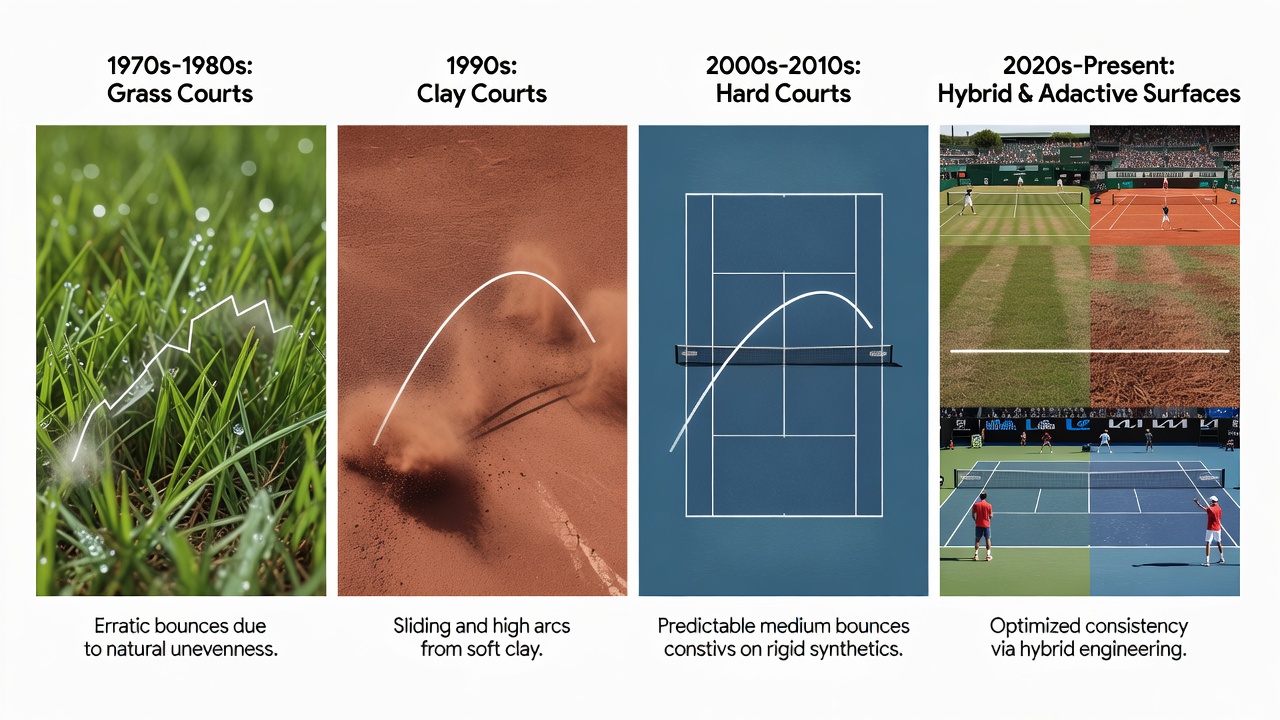
Professional tennis has tracked ball behavior on different court textures since the 1970s, with governing bodies compiling data on bounce height, speed, and directional consistency during major events. Grass courts at Wimbledon produce the lowest and fastest bounces, while clay surfaces at Roland Garros generate higher and slower rebounds, and hard courts at the Australian Open and US Open fall in between depending on the specific coating applied each season.
Grass Court Characteristics and Historical Measurements
Researchers at the International Tennis Federation have measured grass court friction coefficients dropping from 0.75 in the 1980s to around 0.60 by the early 2000s as groundskeepers refined mowing and rolling techniques. These changes produced more predictable forward skids yet introduced variability when wear patterns developed during two-week tournaments, according to match logs from 1995 through 2015. Ball trajectory studies conducted during Wimbledon showed that new balls lost up to 12 percent of their rebound height after 20 games on worn patches near the baseline, creating measurable shifts in depth control for baseline rallies.
Clay Surface Data Across Multiple Eras
Clay courts maintain higher friction levels, typically between 0.85 and 0.95, which slows the ball and increases vertical bounce. Tournament records from the French Open between 1980 and 2020 indicate that clay produces bounce heights averaging 5 to 8 centimeters higher than grass under identical ball speeds, while directional deviation stays below 3 degrees in controlled tests when moisture content remains stable. Dry spells during the 2003 and 2018 editions led to increased skid variance of 7 percent, prompting officials to adjust watering schedules based on real-time humidity readings.
Hard Court Variations and Longitudinal Studies
Hard courts combine asphalt or concrete bases with acrylic topcoats whose grit particle size directly influences friction. Data collected by the Australian Open technical team from 1990 onward shows medium-grit surfaces yielding rebound angles within 2 degrees of target across 90 percent of impacts, whereas coarser textures introduced greater lateral deviation during high-speed serves. The US Open switched to a slightly smoother coating in 2008, after which internal reports noted a 4 percent reduction in erratic bounces during humid evening sessions. Observers note that temperature swings between day and night sessions can alter surface hardness by 8 to 12 percent, affecting ball compression and subsequent flight paths.
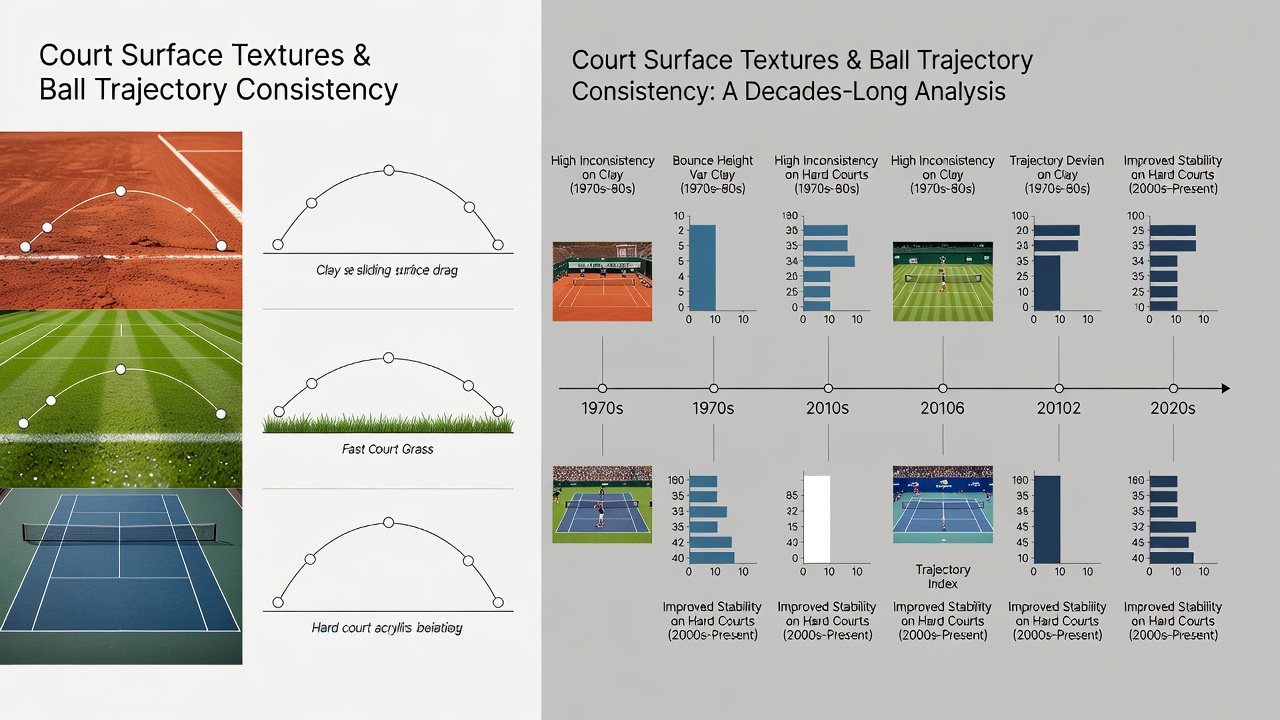
One study from the University of Western Australia examined serve trajectories on outdoor hard courts across three decades and found that wind interaction with surface texture produced additional lateral movement of up to 15 centimeters on second serves when gusts exceeded 12 kilometers per hour. These measurements align with ATP data sets tracking point outcomes on similar surfaces during the 2010s.
Comparative Analysis from Grand Slam Records
Match statistics compiled since 1978 reveal that grass surfaces generate the highest percentage of serve-and-volley points while clay yields the lowest, reflecting differences in bounce predictability rather than player preference alone. Hard court events show intermediate patterns, with trajectory consistency improving after 2005 when uniform ball specifications were adopted across surfaces. Figures from the 2024 season indicate that clay still produces the smallest standard deviation in bounce height during extended rallies, whereas grass exhibits the largest once courts begin to wear after day five of a tournament.
Recent Observations Through June 2026
Through June 2026, the French Open and early grass-court season continue to supply fresh data points on how surface maintenance protocols affect consistency. Updated ITF testing protocols now require daily friction scans, and preliminary results show reduced variance in ball rebound on both clay and grass compared with measurements taken in 2015. These adjustments coincide with continued use of the same ball models, allowing direct year-over-year comparisons of trajectory metrics across the three primary court types.
Conclusion
Decades of recorded measurements demonstrate that court surface textures produce distinct and repeatable effects on ball trajectory consistency, with each Grand Slam surface maintaining characteristic friction and rebound profiles. Data sets spanning grass, clay, and hard courts confirm that maintenance practices and environmental conditions modulate these baseline differences, yet the fundamental ordering of bounce speed and height remains stable across tournament records. Ongoing monitoring through 2026 continues to refine understanding of these interactions without altering the established patterns documented since the late twentieth century.