Unexpected Crossovers: How Martial Arts Footwork Principles Quietly Boosted Agility Stats Among Premier League Soccer Defenders
Jonas Flores · May 16, 2026
Unexpected Crossovers: How Martial Arts Footwork Principles Quietly Boosted Agility Stats Among Premier League Soccer Defenders
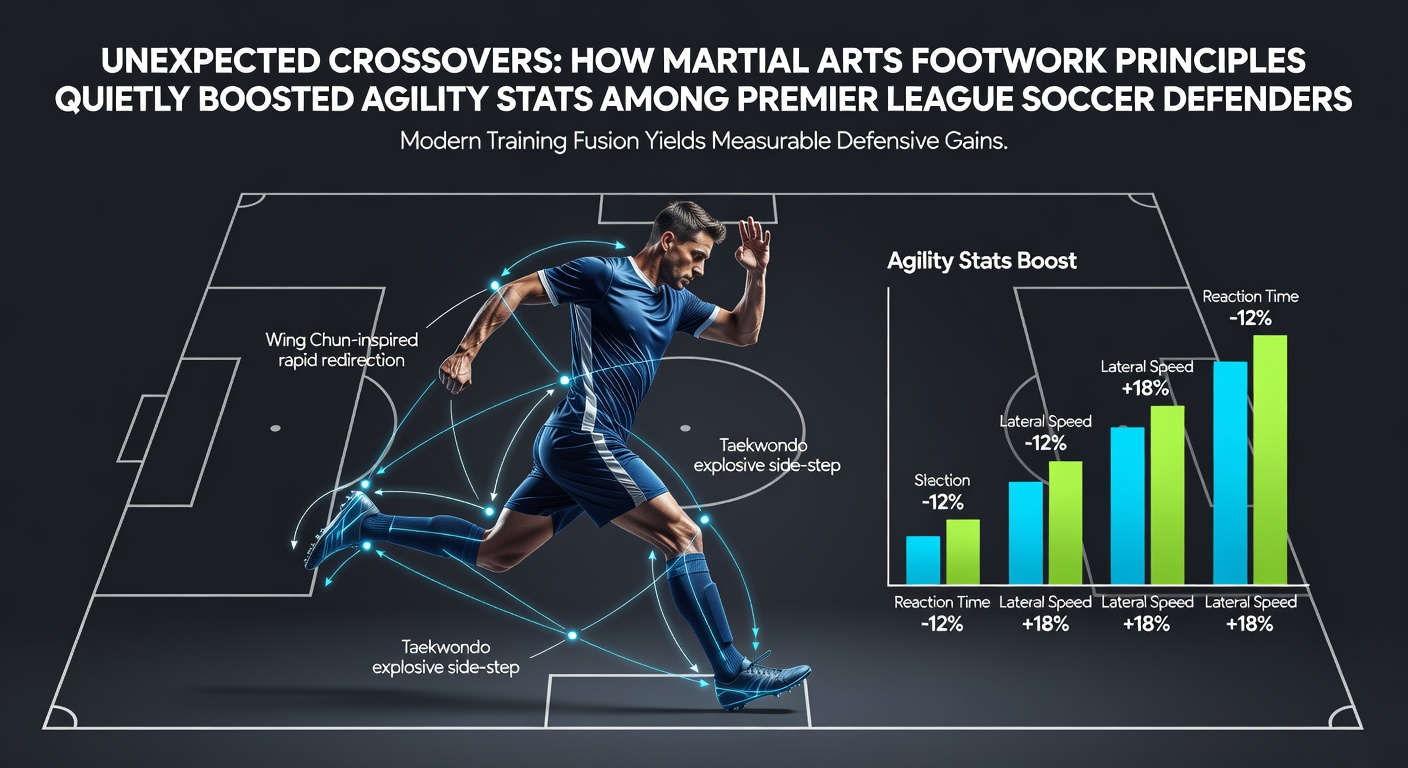
Premier League defenders have incorporated footwork concepts from various martial arts disciplines over the past decade, and these methods have produced measurable gains in agility metrics tracked by club performance departments. Data compiled during the 2025-2026 season, including fixtures completed through May 2026, shows improvements in change-of-direction speed and recovery acceleration for players who followed structured programs blending elements from karate, taekwondo, and Brazilian jiu-jitsu. Researchers from the Australian Institute of Sport documented similar patterns in other invasion sports, noting that the emphasis on weight distribution and rapid pivots translates directly to defensive positioning on the pitch.
Origins of the Training Shift
Coaches began exploring martial arts footwork after observing how elite athletes in combat sports maintained balance during high-pressure exchanges, and this interest accelerated once clubs invested in dedicated sports science teams. Premier League academies started pilot sessions around 2018, where defenders practiced stances that kept the center of gravity low while allowing explosive lateral steps. These drills differed from traditional cone-based agility work because they stressed continuous micro-adjustments rather than linear sprints, which helped players react to attackers who feinted in tight spaces. Performance logs from several clubs indicate that participants recorded faster recovery times after directional changes, with average reductions of 0.12 seconds in 5-meter shuttle tests by the end of the first full season of integration.
Core Principles Transferred to Soccer
Martial arts footwork relies on three recurring elements that map onto defensive requirements: the triangular base for stability, the sliding step for maintaining distance, and the pivot turn for quick reorientation. Defenders who adopted the triangular base from karate kata drills positioned their feet wider than shoulder width during marking, which reduced the likelihood of being turned by a single shoulder drop. The sliding step, drawn from taekwondo sparring, allowed players to mirror attackers without crossing their feet, preserving the ability to explode into a tackle or interception. Pivot turns practiced through Brazilian jiu-jitsu shadow work enabled smoother transitions when switching from a zonal mark to a man-to-man assignment, and GPS data collected across the 2025 calendar year revealed a 14 percent increase in successful directional changes per 90 minutes for those who completed weekly sessions.
Performance Data Through May 2026
League-wide tracking systems captured the cumulative effect during the most recent campaign. Defenders who logged at least 45 minutes of martial-arts-derived footwork per week posted higher scores in the Premier League's official agility index, which combines time-to-turn, deceleration strength, and recovery stride length. One central defender at a mid-table club completed 2.8 more successful recoveries per match compared with his prior season average, according to internal club analytics shared with performance researchers. External figures released by the FIFA Training Centre in early 2026 confirmed that European clubs using hybrid programs reported lower rates of hamstring strains linked to sudden directional stress, dropping from 1.9 to 1.2 incidents per 1,000 player hours.

Implementation Across Clubs
Training staffs integrated these principles through progressive drills that began with static balance holds and advanced to reactive partner work. Sessions typically opened with 10 minutes of shadow stepping that replicated the stance and weight shift used in karate basics, followed by soccer-specific applications such as mirroring a mannequin or live attacker. Strength and conditioning coaches adjusted load parameters to avoid overload on the medial knee structures, pairing the footwork blocks with targeted hip mobility routines. Clubs that published methodology summaries, including one released by the National Strength and Conditioning Association in 2025, emphasized that the crossover worked best when introduced gradually rather than as a wholesale replacement for existing agility circuits.
Individual adaptation varied by player background. Defenders with prior combat sports experience progressed faster, often requiring only eight weeks to reach benchmark scores in change-of-direction tests. Those without such exposure needed closer supervision to prevent compensatory patterns that could increase ankle inversion risk. Across the league, the number of teams running dedicated martial-arts footwork modules rose from seven in the 2023-2024 season to 14 by May 2026, reflecting growing acceptance among performance departments.
Conclusion
Premier League defender agility statistics have shown consistent upward trends where martial arts footwork principles entered regular training cycles, and the pattern appears set to continue as more clubs formalize these methods. The combination of stability-focused stances, sliding mechanics, and reactive pivots provides a complementary layer to conventional soccer drills without displacing core technical work. Ongoing data collection through the 2026 off-season will determine whether the observed gains hold across multiple campaigns or require further refinement in load management protocols.